Since today is Sunday, I plan to stop by my workshop for a while in the afternoon. It is sunny and warm again today, but it seems the weather will get worse again in a couple of days. In early spring in Japan, the weather is often unstable, and even in April, there can still be cold days. This is also the time when cherry blossoms begin to bloom, so the news often talks about concerns that rain or unstable weather may cause the blossoms to fall too soon. Strong winds are also common during this season, sometimes called “spring storms,” which makes it even more of a concern. There is even a Japanese term, “hanabie” (hana=flower / bie=chill), which describes the cold days in early April when the cherry blossoms are blooming.
Recently, I have had more chances to see some vintage puzzle boxes, so I thought I would introduce them here from time to time. Since the number is limited, I’m not sure how long I can continue this, but for now, I will start by writing about a box I recently shared on Instagram and Facebook.
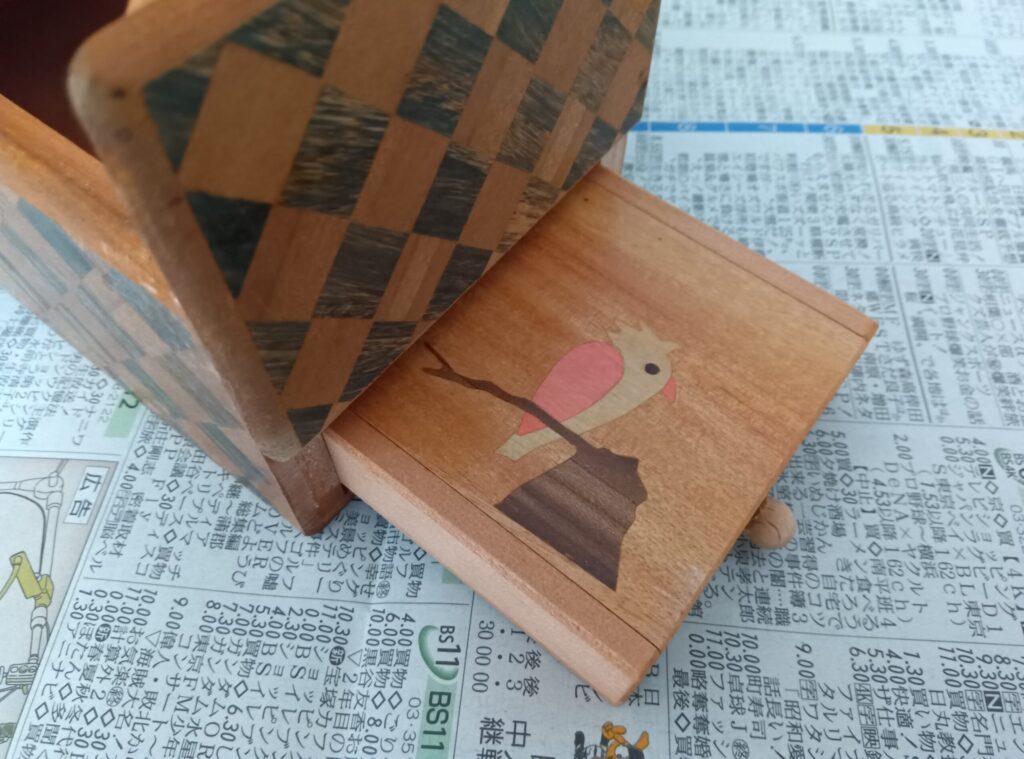
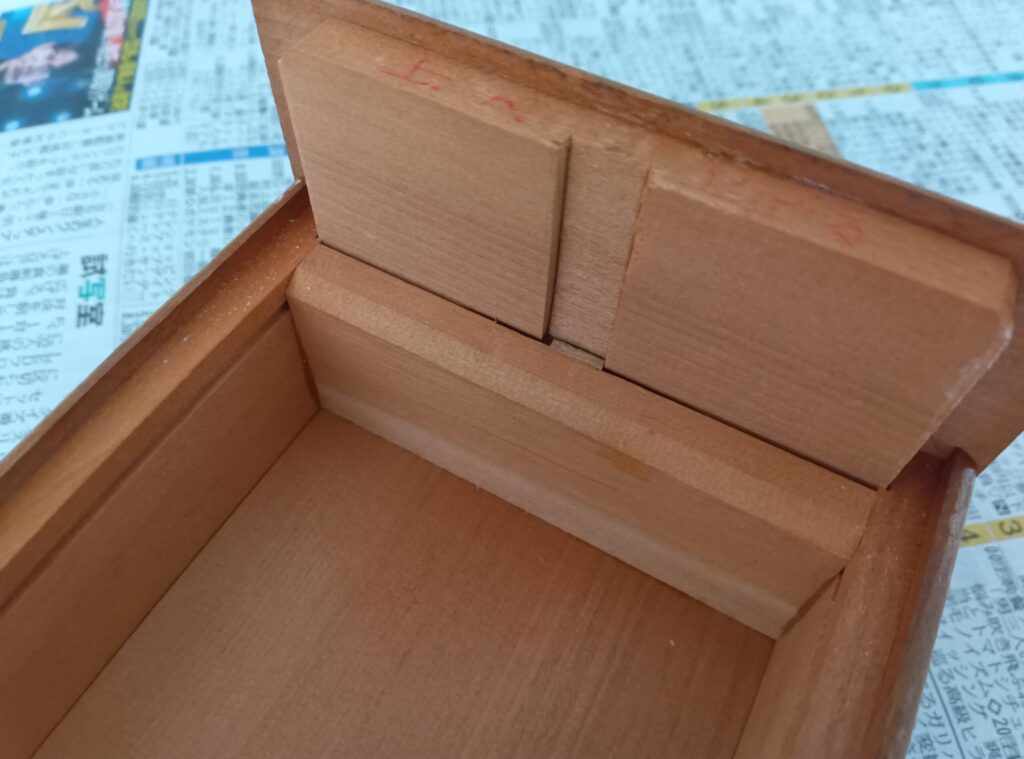
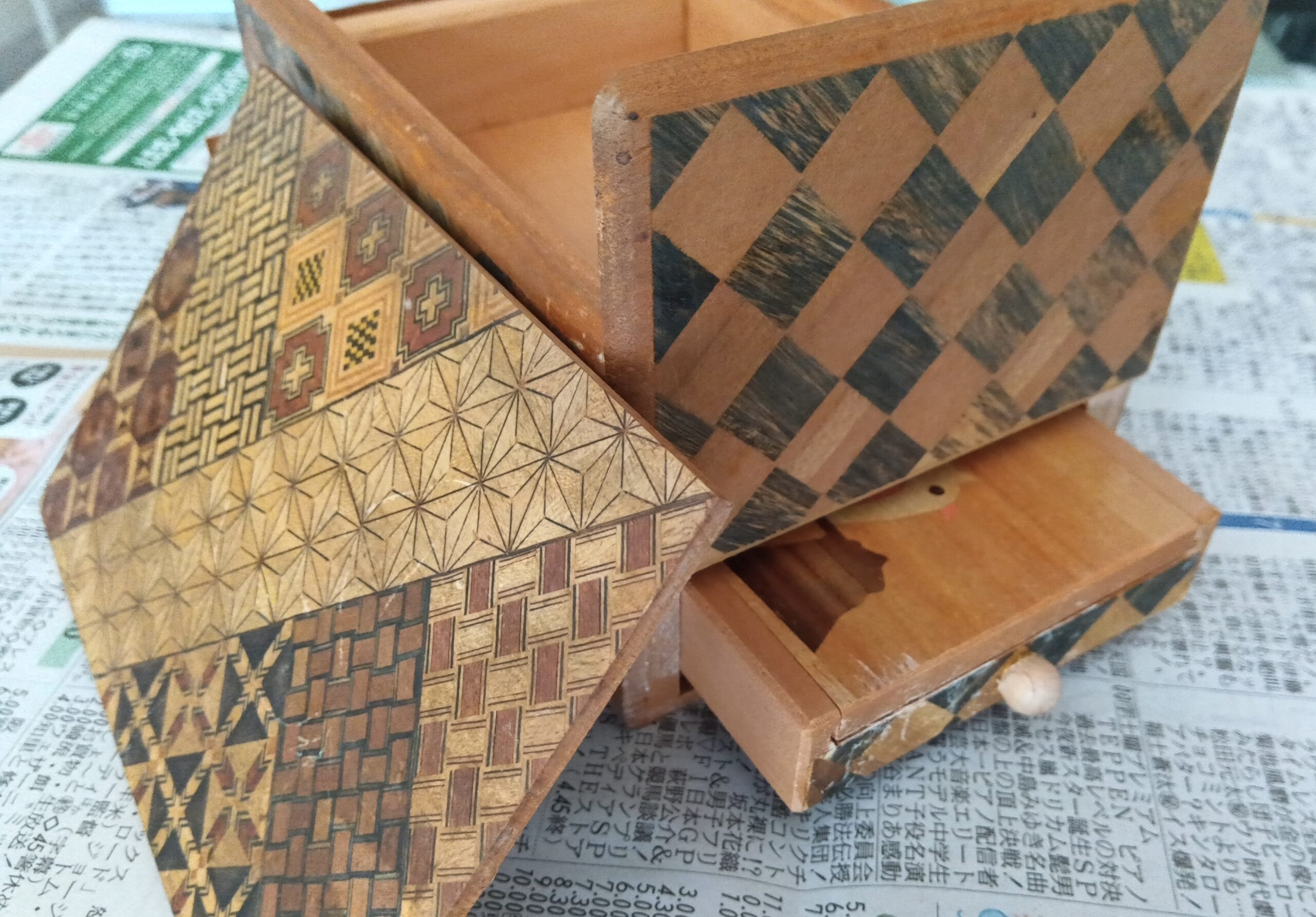
This is a 5-sun 10-steps puzzle box. It is a model with a drawer that comes out from inside, and when the drawer opens, it makes a sound, so it is a “sound drawer himitsubako.” The condition is quite good. The mechanism feels a little stiff, but it works without any problems. The first thing I noticed was that the side panels are not warped at all. Many boxes from this period remain flat even after many years, which is quite impressive. Even though the coating is not very thick, the panels have not changed despite being exposed to the air over time. One of the reasons for this durability is likely the quality of the material. It is made from well-dried katsura wood. After being cut into boards, the wood was left to dry for many months or even years in a sheltered outdoor space (protected from rain). The wood is fully seasoned. All parts of this box are made from this katsura wood. The finish does not seem to be the old wax-rub method, but it was applied by hand with a brush, and it is quite thin. Another reason the panels have not warped may be that this box has remained in Japan. In countries with much drier climates, the wood might have been affected differently.
In recent years, some craftsmen have started making sound puzzle boxes again, but in the past, this feature seems to have been commonly used in boxes with drawers. It is very unique and surprising. Another characteristic of boxes from this period is that the lid of the hidden drawer often has a bird wood inlay. This likely represents the idea that the sound is like a bird’s call. It feels very charming. I used to think that life in old Japan was more formal and less casual than today, but there are actually many puzzle boxes with playful and cute wood inlay designs like this. It seems that the craftsmen who made these inlays had a great sense of playfulness.
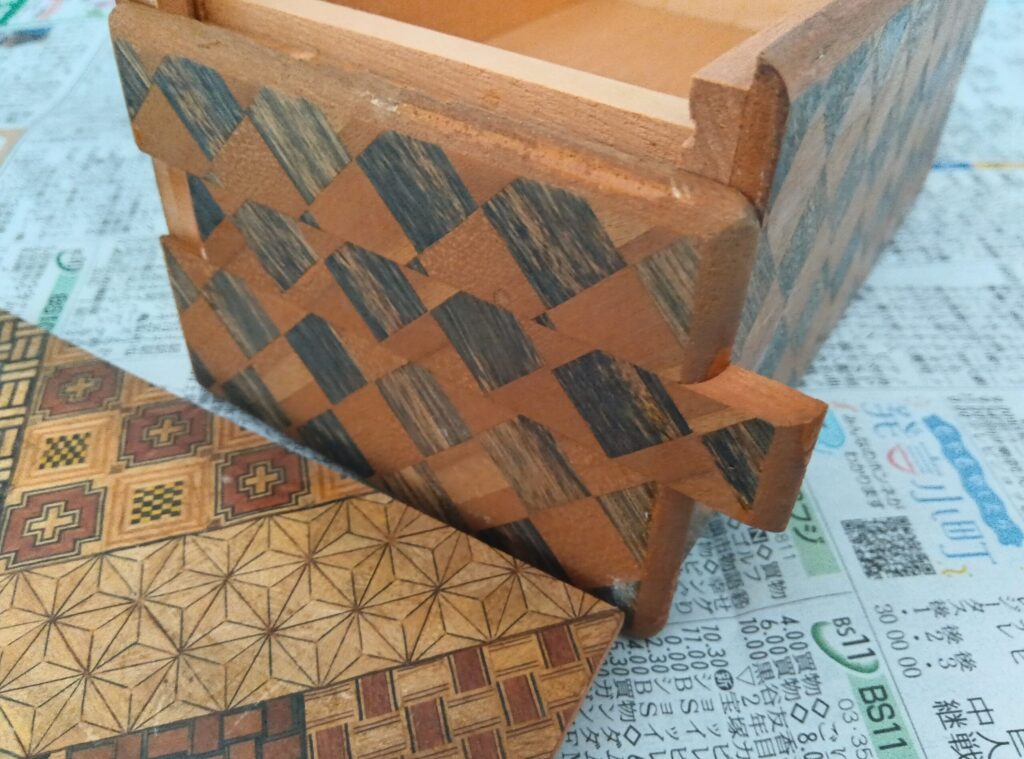
Another visual feature is the large ichimatsu pattern used on the side panels. This design is still used sometimes today, but this larger checkered pattern is often seen in older puzzle boxes. The sliding keys are quite loose now. I cannot see inside, but I believe the internal stepped structure was carved directly into the axis panels. These axis panels are also made from katsura wood, which is quite soft, so over many years of use, the inside has likely worn down and become loose. The sliding keys are relatively narrow. In modern boxes, the sliding keys tend to be made wider, but this one has a narrower design. The way the Aruki panel stops at the 8th step follows a traditional method. The internal groove is shaped to stop partway, and it catches on a small wooden piece attached to the axis. As for the adhesive, it does not seem to be modern wood glue, but rather a traditional glue, likely animal glue (nikawa).
There are many more things I could talk about, but it might get too long, so I will stop here for today. According to the information I received, this box may have been made by Noboru Honma. There is no signature or stamp inside the box, though. Mr. Honma is still active today and continues to create wonderful work as a skilled craftsman.