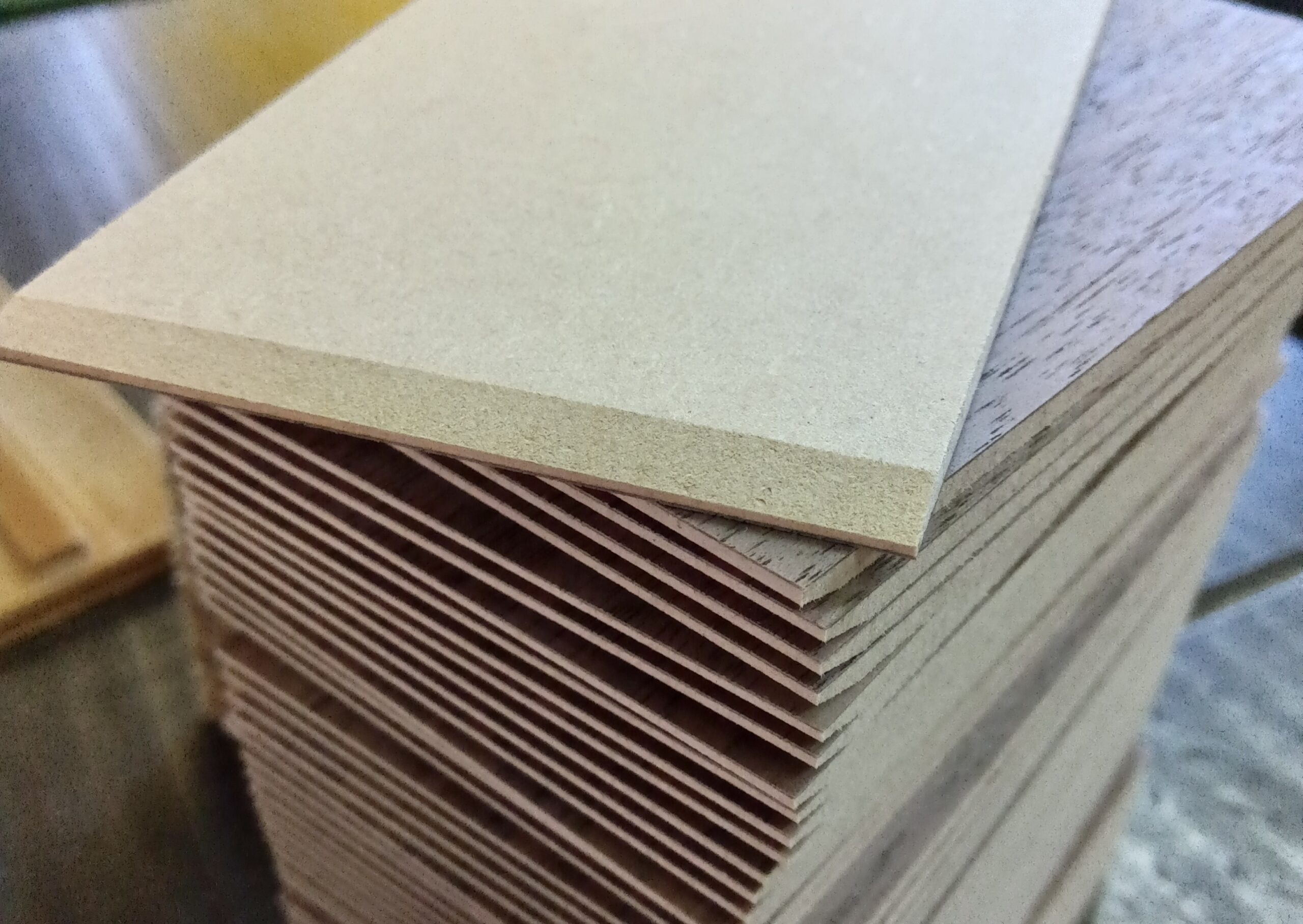
Today was sunny and the weather was really nice. I paused the work on the Mame 1-sun puzzle boxes for a bit and worked on the 4-sun 18-steps puzzle boxes that I had stopped earlier. The humidity was high yesterday, so I decided not to make and attach the top and bottom panels. I started that work this morning. This time, there are a few traditional yosegi style boxes, but for most of them, I use walnut and a little zebrawood for the top and bottom panels. The walnut and zebrawood are thin natural wood sheets attached to my usual MDF boards (engineered boards) (photo). You can buy ones attached to plywood, but you can’t find them attached to MDF boards, so I make them myself. By the way, attaching these thin wood sheets took me years of trial and error. I would like to write about it someday, but it is actually quite difficult to attach them properly. If it is not done well, they can peel off later. It also depends a lot on the type of wood.
MDF boards may look a bit like cardboard at first, but they are actually made from wood. They are made by mixing very fine wood fibers with glue and pressing them into a solid board. Because of this, the inside is very dense, and unlike natural wood, there are no gaps inside. One downside is that they are a bit heavy. If you don’t use too much, it’s not a problem, but if you make a whole piece only with MDF boards, it becomes quite heavy. So I only use them for the top and bottom panels, or for the inner partitions. The panels are usually about 2.5 mm thick. Another weakness is that MDF is not strong against water. If even a small drop of water gets on it, that part will swell, and it will not go back to its original shape. So you need to be careful when taking uncoated MDF boards outside. For this reason, I feel a bit hesitant to use them on rainy or very humid days. That’s why I didn’t work on them yesterday. Of course, I don’t work outside, and a little humidity may not cause big changes, but for Japanese puzzle boxes, even a very small change can affect the feeling of the mechanism. Today, it was sunny from the morning and the humidity was quite low, so I could work with confidence.
So, with all these downsides, why do I still use MDF boards? The main reason is how easy they are to work with. As you can see in the photo, the surface is very uniform. Natural wood and plywood usually have grain. When you cut along the grain, it goes smoothly, but when you cut across it, the blade can meet resistance, or the wood can chip. When I do angled cuts like the panels in the photo, if I don’t hold the material firmly, the edges can easily chip. MDF boards don’t have grain direction, so I can work from any direction in the same way. It may not be as interesting as working with natural wood, but I use it where it is needed. Another advantage is the cost. In recent years, the price of wood and plywood has gone up a lot, but MDF boards have not changed so much. Also, some home centers sell their own original MDF boards at a very low price. I don’t use large amounts, so cost is not a big factor for me, but it still helps.
Today, I attached the top and bottom panels in the morning, and in the afternoon, after a few hours, I was able to finish making the sliding key panel and attaching one side. Another advantage of plywood and MDF boards is that after gluing, I can move on to the next step in just a few hours like this.