This morning it was cloudy with a little rain. But it is not very cold, and it already feels like spring is coming. From today in Japan, we have a period called Ohigan. It is a time when people believe the world of the living and the world of the ancestors become close. Many people visit graves and pray for their ancestors. The period lasts until the 23rd. By the way, Ohigan happens twice a year in Japan, once in spring and once in autumn.
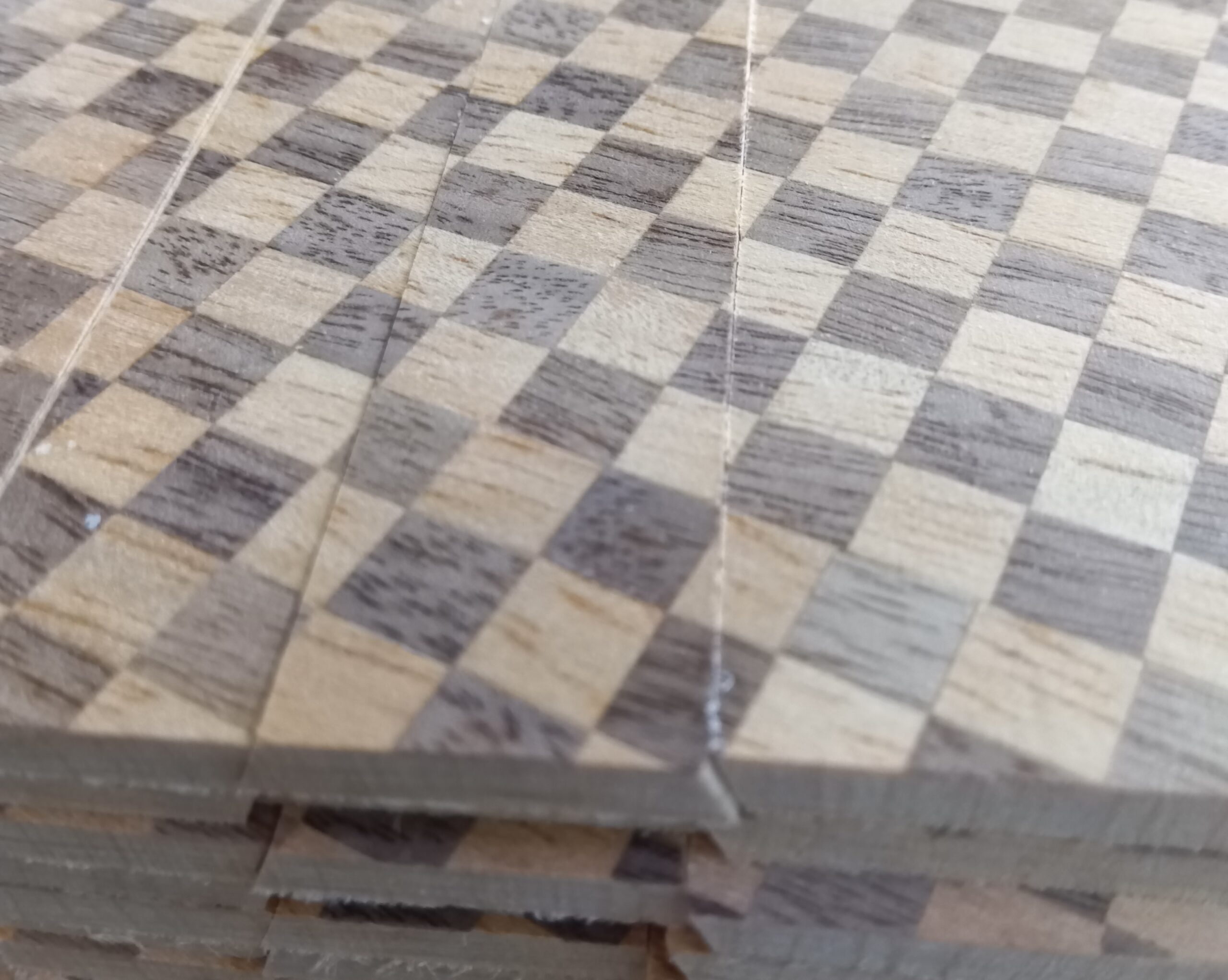
Today I plan to go home a little earlier, so from the morning I only worked on making and attaching the sliding key panel for the 5-sun 27-steps puzzle box. I attached small wooden parts (bocchi) inside and create the sliding keys, and attached only one side for now. The photo shows the sliding keys of my new boxes, made with traditional yosegi and Ichimatsu yosegi patterns. As I shared on Instagram the other day, this color combination was very popular, so I am thinking of continuing to use it for the side panels of the 5-sun boxes. However, with this size of Ichimatsu pattern, the misalignment is relatively hard to notice. Because the pattern is regular and simple, there may be a kind of visual illusion that makes it less noticeable. On the other hand, traditional yosegi has more distinctive patterns, so even a small shift can feel a bit strange, and people may notice the misalignment more easily. As for why the pattern shifts, I have mentioned this before. When I cut the board with yosegi sheets using a saw, part of the pattern is lost as sawdust due to the thickness of the saw blade. This causes the misalignment. To reduce this shift, it is important to use as thin a saw as possible and make careful cuts like the ones shown in the photo. However, I have tried many options, and if the saw is too thin, the cut can become slightly curved. A very thin saw seems to lack enough cutting strength, so it cannot cut cleanly against the strength of the wood fibers. So for now, I choose a saw that is as thin as possible but still strong enough, considering the thickness, size, and number of teeth.
Another important point when using a thin saw is that the wood being cut should be soft. Of course, I use agathis wood, but even within that, I choose parts that have straight grain and are relatively soft. However, if the wood is too soft, there is a risk. When I round the corners of the box at the final stage, the side edge of the sliding key panel is the end grain of the wood, and that part can become rough and crumbly. So I need to be careful. This used to happen more often before, but recently it has become less common. These days, lighter and softer parts of agathis are harder to find, and instead, slightly harder parts are more common. This is probably because naturally air-dried logs are no longer being imported, and only kiln-dried wood is available. Kiln-dried wood tends to become harder in texture.