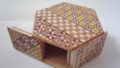
Today was a very warm day. Just as the saying “sankan shion” suggests, it seems that cold and warm days are coming alternately every few days. While taking care of a few other errands, I continued working on the 5-sun 27-steps puzzle boxes. I had thought about leaving the frame panels clamped in the vise a little longer, but since the weather was good and my other tasks had settled down, I decided to move ahead and make the frame parts today. The axle panels had already been made yesterday, so today I worked only on the side panels. This time I am making two types: the traditional yosegi type and the ichimatsu yosegi type. The ichimatsu yosegi version has a traditional yosegi top panel, and it is the second model of this design following the 14-step box I made recently. I plan to offer this one for sale here as well.
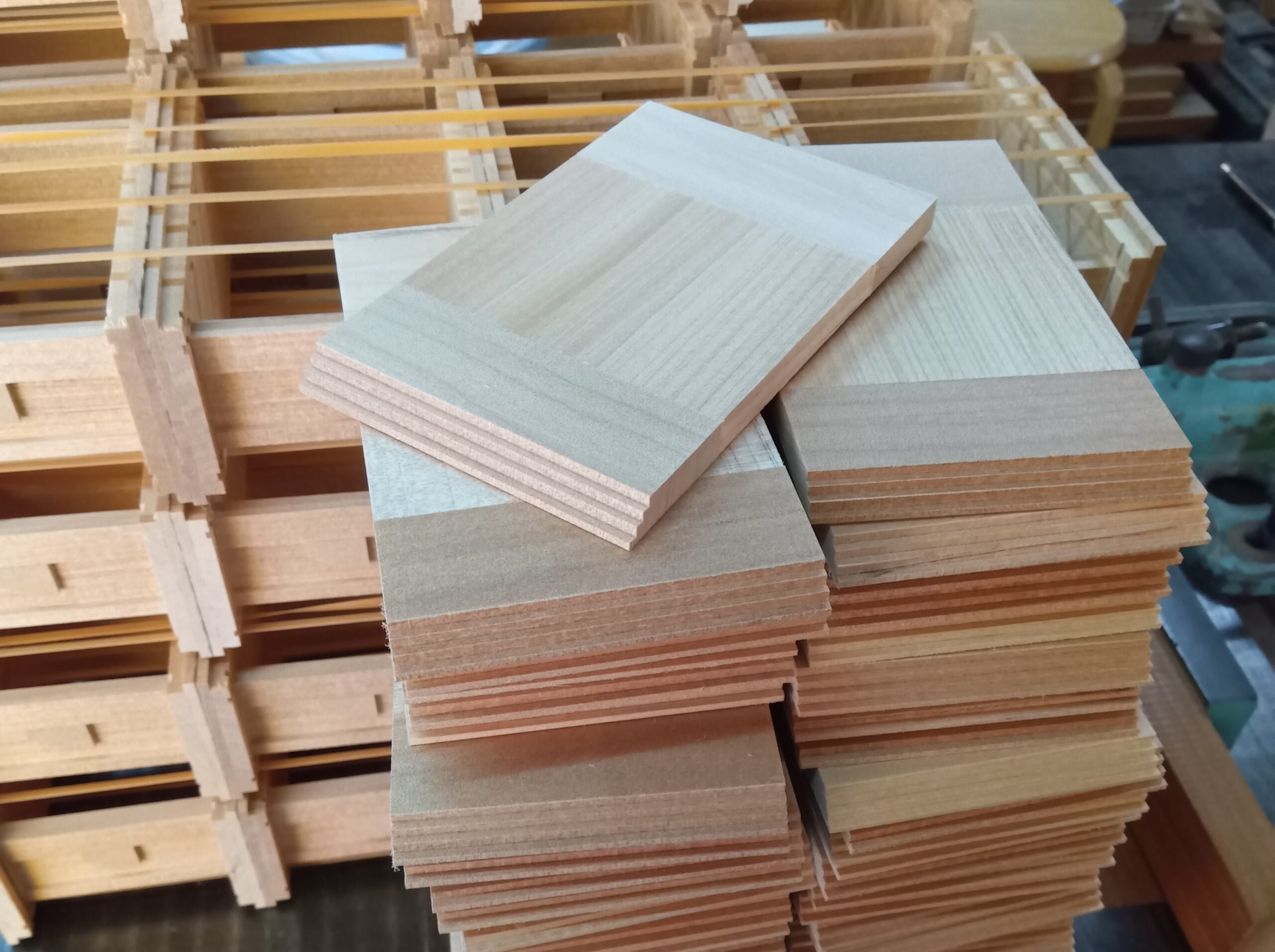
After that, I also did some work attaching parts to the assembled frame panels. I have not installed all of them yet, but I would like to finish attaching them by next week, before making the Aruki panels. In the photo, you can see the assembled frame parts together with the panels that will be used for the top and bottom. I made these panels at the same time when I produced the axle panels yesterday. They have not yet been processed into Aruki panels, but I have already done the hashibami process. Hashibami is a method used to prevent a panel from warping by gluing together three boards with their grain running in different directions. In the past, I used to make the stepped cuts at the tip after doing this process. However, now I first prepare the pieces with the stepped shape, and then glue them together to make the hashibami panels. In the same way, the side Aruki panels are also given this stepped cut while the boards are still in a long piece. There are two main reasons for making these zigzag cuts at this stage instead of doing them one by one later. First, it is more efficient and allows the work to be done more quickly. Another important reason is the level of precision required. These zigzag cuts need accuracy down to about 0.1 mm, and it is easier to achieve that precision when working with freshly cut boards. For example, after the hashibami process, very slight misalignments can occur during the gluing stage, and the board may no longer be perfectly flat. The difference is very small, but when working at a precision of 0.1 mm, even such a small irregularity can affect the result.
And today I also decided on the next project. The next boxes will be the 4-sun 18-steps puzzle boxes. Some of them are being made for an order, but for my own stock I plan to add versions with walnut and zebrawood top and bottom panels. I may also make a few of them in the random grain style again.
As many of you know, the war currently taking place in the Middle East is causing problems with the oil trade. The Japanese government also seems to be busy responding to the situation. In Japan, gasoline prices suddenly increased starting on the 12th. In our area, regular gasoline is now 189 yen per liter (about 7.15 USD per gallon). Until last week it was around 140–150 yen, so it has jumped by about 40 yen at once. The Japanese government plans to introduce subsidies starting next week and also release some of the national oil reserves. Japan depends on the Middle East for about 80% of its crude oil imports, so it is said that the impact here may be greater than in many other countries. There is also concern that this situation could affect many other things besides oil, so it is something we will need to keep watching closely.