It is Sunday today, and unusually I am at home at this time 😅. I am thinking of going out for a while later and also stopping by the workshop. Now that it is March, the mornings and evenings are still a little cold, but during the day it has become quite warm. Speaking of March, around the middle of the month in Japan there is a Buddhist period called Higan, when it is believed that this world and the other world come closest together. Many people visit the graves of their ancestors during this time. Higan occurs both in spring and in autumn (around September). There is also an old saying in Japan: “Heat and cold last only until Higan.” In other words, it means that the change of seasons happens around this time. The phrase also carries another meaning—that difficult times will eventually pass once that period is over.
The other day, the “garbage calendar” for our neighborhood arrived. As I wrote before, Japan’s new fiscal year begins in April, so the calendar is given out around this time. In Japan, the rules for disposing of garbage are quite detailed. The basic system is set at the national level, but the exact way to sort and put out garbage differs from one city or municipality to another. Because of this, people who have recently moved to a new area are sometimes confused and may put out their garbage incorrectly. When that happens, a very noticeable sticker saying “Rule Violation!” is placed on the garbage, and it is left there instead of being collected. The person who put it out must then take it back home. Garbage is usually placed at a shared collection point for a small group of homes called a “kumi,” which typically includes about ten to twenty households. Everyone in that group must bring their garbage to that one location. However, because this system makes it difficult to know who put out the garbage, some municipalities have started individual collection. In that system, each household places its garbage in front of their own home on the designated day. That way, if the garbage is sorted incorrectly, it is immediately clear which house made the mistake. Recently, the rules for putting out garbage have become quite strict.
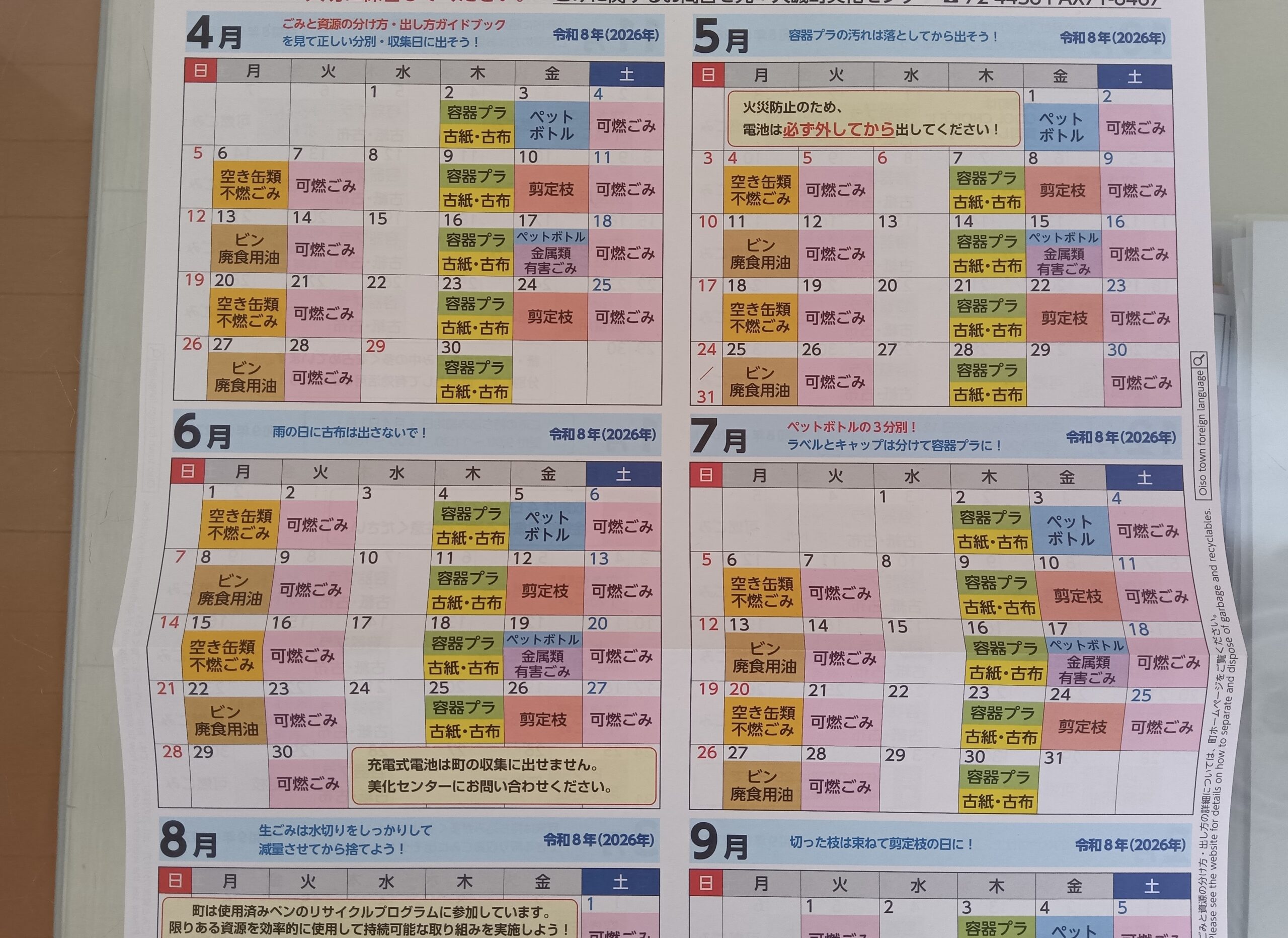
Of course, it is not possible to put out garbage whenever you like. As shown on the calendar in the photo, the collection days are carefully scheduled. For example, there are days for “burnable garbage,” “plastic bottles,” or “recyclable plastics.” Along with the calendar, a booklet explaining how to sort the garbage is also distributed. It describes the sorting rules in detail. The regulations are quite specific, and if you do not read them carefully, it is easy to make a mistake 😆. For example, plastics are divided into items that can be recycled and those that cannot. Nowadays, many products have marks on the back indicating whether they can be recycled, so people can check and decide based on those marks. In particular, trays used for food packaging are actively collected. They are recycled and turned into new products. Plastic bottles are also collected not only by the municipality but often at supermarkets as well. Many supermarkets have collection boxes where you can bring them. Some stores even give points that can be used in the shop if you bring in these recyclable items, so many people do so. I also collect plastic bottle caps because they are used to help fund vaccinations for children overseas. I save quite a lot of them, and when I have collected enough, I take them to a collection box. As shown on this garbage calendar, the collection schedule in the municipality where I live is as follows: burnable garbage twice a week, recyclable plastics once a week, old paper and cloth once a week, and bottles, cans, plastic bottles, and metals once every two weeks.