Because I was out for a long time yesterday and couldn’t make much progress, I worked on the 6-sun boxes from the morning today, as usual. The delivery deadline is the 29th or 30th, so I want to stay ahead of schedule to avoid any delays. From yesterday evening the weather turned rainy, and today it kept raining on and off. Fortunately, I’m not yet at the stage of making or attaching the Aruki panels, so the rain didn’t affect the work. Today I prepared the remaining materials for the 6-sun boxes, and I made the frame panels and the shaft panels.
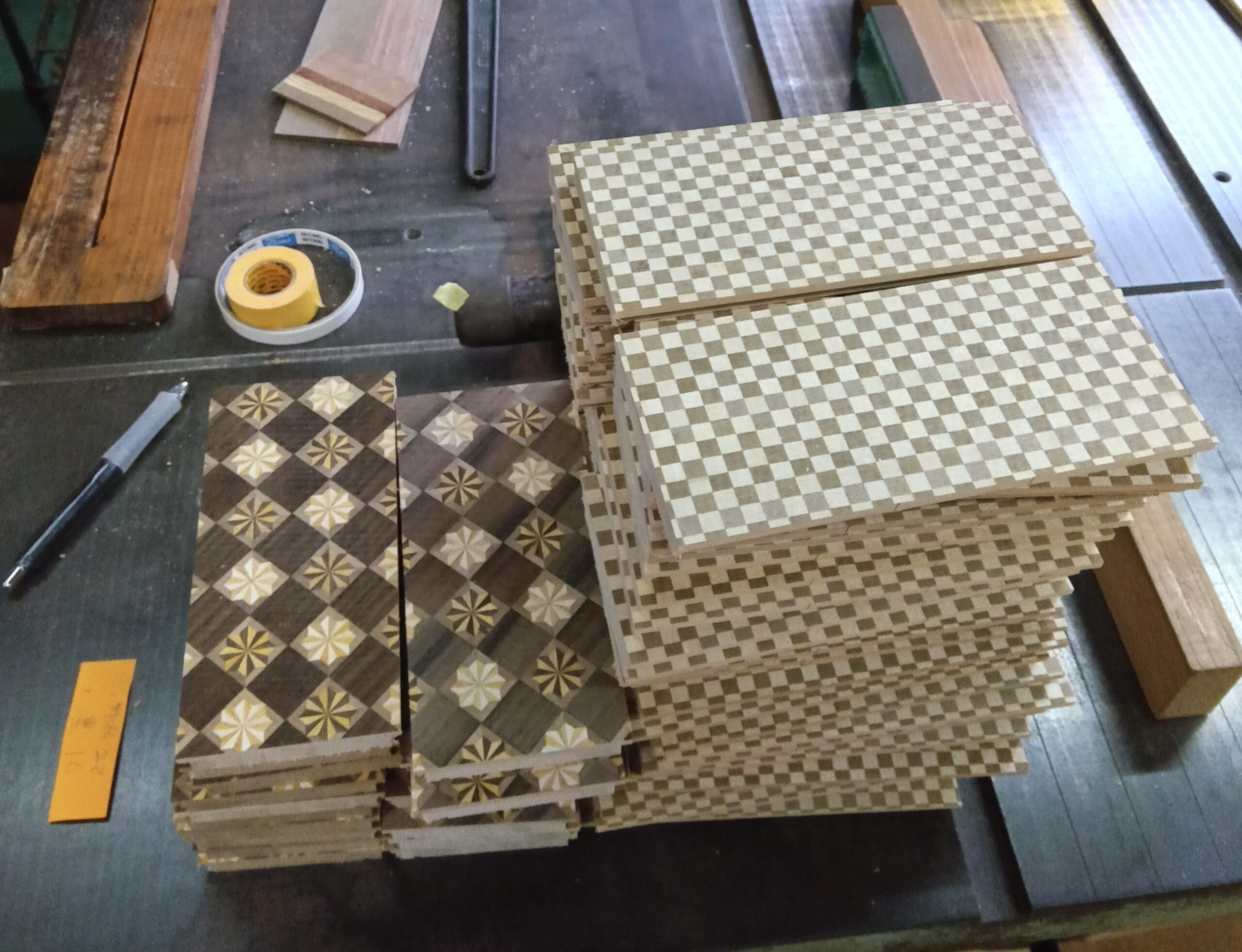
The photo shows the side frame panels I will use for this box. At first, I planned to make all the boxes with the two-tone checkered yosegi on the right, but I ran out of it, so about ten boxes will be made with the darker pattern on the left. It’s an unusual design, but I don’t know its name 😅 I think it was probably created by the craftsman who originally made it. Some people may want this unique pattern, but unfortunately I can’t sell it here because it belongs to a supplier in Hakone, not to me. This pattern is most likely no longer produced and is quite old. Over the past twenty years, the Hakone craft industry has changed a lot. Many wholesalers that handled yosegi products and other Hakone crafts have closed, and now the number is about one-third of what it used to be. The main reasons are Japan’s long recession and the decline in popularity of traditional crafts. Even though many tourists still visit Hakone, not many people buy these craft items. Because of this situation, when a shop or wholesaler closes and cleans out their storage, old yosegi pieces like this sometimes show up. In the past, when business was unbelievably good, craftsmen made enormous quantities—not only standard traditional yosegi (koyosegi), but also rare designs like this. Craftsmen were extremely busy back then, often working late into the night or even all night. The pattern I’m using this time was probably intended for trays, small drawers, or other items. Occasionally, a supplier visits me and asks if I can make puzzle boxes using old yosegi like this.
According to yosegi craftsmen, designs other than traditional koyosegi are interesting and sell well at first, but almost no one asks for a second production run. Because of that, unusual patterns like this often end up leftover in storage. This happens because of how yosegi sheets are made — the process always produces 200 to 300 sheets at a time. Even if only a small amount is used, the rest remain. But in the old days, business was so good that even if some sheets didn’t sell, Hakone wholesalers kept asking craftsmen to make new and unusual designs one after another.
However, for larger patterns like the one I’m using this time, they work fine on a 6-sun box, but on smaller boxes the pattern tends to shift and looks a bit unbalanced. I once made 3-sun boxes with this same pattern, and the design didn’t sit nicely in the center — it ended up looking a little off. In the end, the traditional small-pattern yosegi (koyosegi) seems to remain the standard, no matter the era.