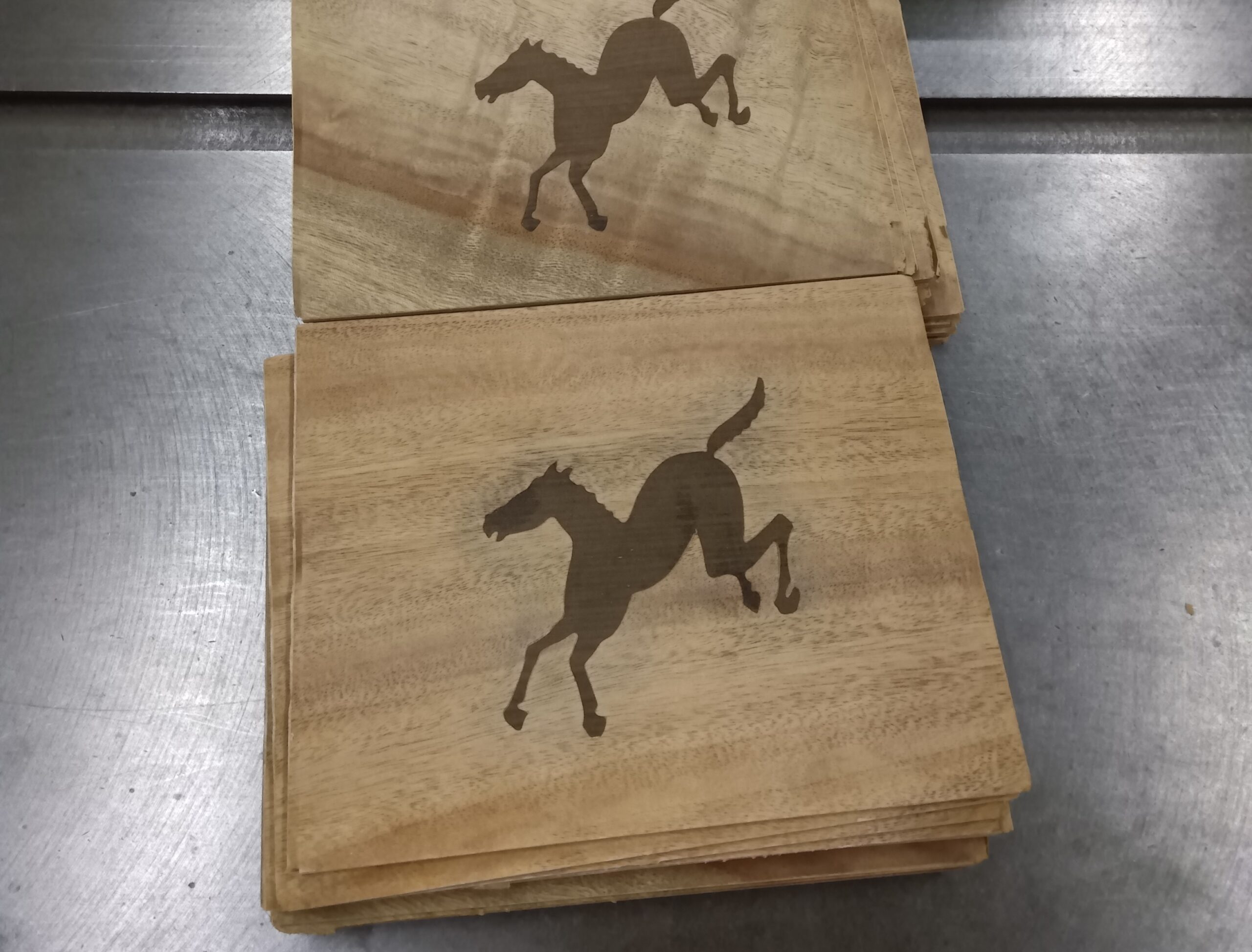
Today started with rainy weather. I came to my workshop a little later than usual and did a bit of work. I also had some errands, so I only worked on the 6-sun boxes for the Hakone market that I started yesterday. As I wrote before, these boxes use a wood inlay design for the top panel, but I’m not sure who created this inlay. It was given to me by a Hakone supplier the other day, and it seems to be quite old—the colors feel a little aged. By the way, the base material is Kusu (camphor) wood, and I think the horse design is made from Katsura jindai wood. They might know who created it. After all, there are only a few people making wood inlay nowadays—maybe around four, as far as I know.
We have a system for traditional crafts that are officially certified by the Japanese government. Hakone yosegi zaiku — the geometric wooden patterns — is one of the crafts that has this certification. However, Himitsu-bako (Japanese puzzle box) and mokuzōgan (wood inlay) are not certified. Puzzle boxes are often sold together with yosegi, so sometimes people think of them as a part of Hakone yosegi zaiku. But by themselves, they are not recognized as a national traditional craft. Honestly, I don’t think this certification makes a big difference. When customers buy items in Hakone shops, they usually don’t worry about whether something is certified or not — they simply choose what they like. Mokuzōgan pieces are often sold as artworks, framed like pictures, but it seems they don’t sell very well. Maybe they would sell if they were cheaper, but in reality they are quite expensive. In fact, some of them might even be more expensive than puzzle boxes.
I don’t think that is the only reason, but the number of mokuzōgan (wood inlay) craftsmen is very small, and there is no sign that it will increase. Of course, wood inlay exists all over the world, so it’s not a rare craft by itself. But the style of mokuzōgan made in this region is very unique, and that is its special point. Here, the technique is called “Hikinuki”. The craftsman tilts the scroll saw a little and cuts out the shapes so they can be fitted into the base board like pieces of a puzzle. This method can be used even on thicker wooden boards. In many other countries, wood inlay is usually made from very thin pieces of wood, about 0.2 mm, cut with a knife to create a picture. Each artwork is created one by one. But in this region, because the pictures are made from thicker boards, the completed design can be sliced — just like yosegi sheets — to make many copies of the same image. Traditional yosegi sheets are sliced into about 200–300 pieces, while mokuzōgan is usually sliced into around 100–150 pieces. This method is a unique local technique that allows for a kind of “mass production.”
I used to know a very skilled mokuzōgan craftsman, and we were quite close. He has now retired because of his age, but he used to make wood inlay pieces for my puzzle boxes. He didn’t have any apprentices, so his work ended with his generation. His signature piece, called Sansui (“mountain and water”), was beautifully made 😊